Before You Step Outside, Look Again. |
Heat, Smoke and Fire Are Creating a New Kind of Summer Emergency |
Before You Step Outside, Look Again: Heat, Smoke and Fire Are Creating a New Kind of Summer Emergency
The sky may look blue.
The sun may be shining.
Your phone may show no approaching storm.
And you may still be walking into dangerous conditions.
That is what makes the current combination of extreme heat, wildfire smoke and drought-driven fire so different from the disasters most of us were taught to recognize.
There may be no siren.
No thunder.
No wall of water racing down the street.
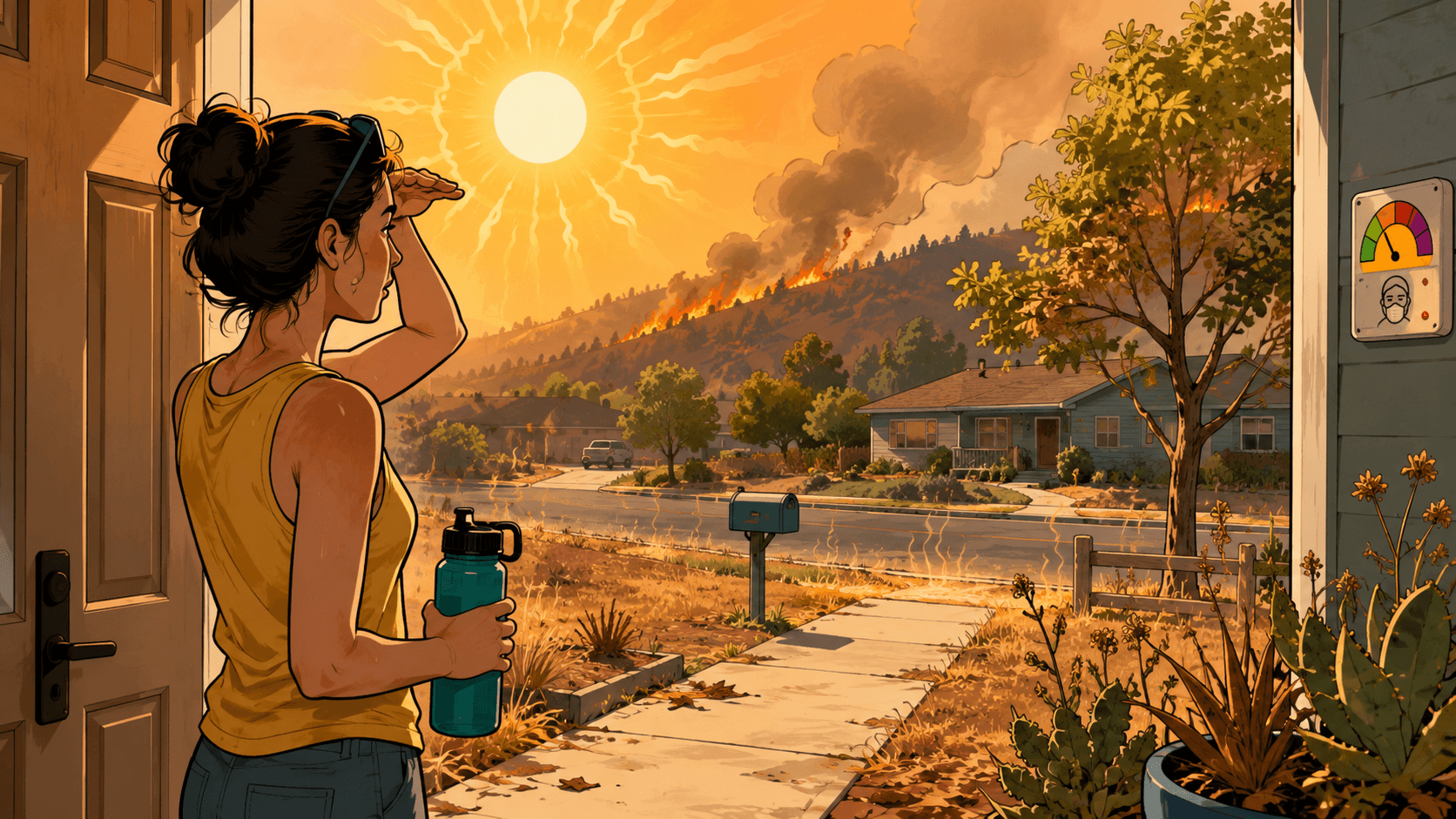
Instead, the danger can arrive as a faint haze on the horizon, an unusually orange sun, a dry feeling in your throat or a wave of exhaustion that you dismiss as simply being tired. And that is precisely why we need to pay attention.
A Disaster Does Not Have to Arrive All at OnceAs of July 15, 2026, extreme heat and wildfire smoke are affecting enormous sections of North America.
More than 100 wildfires are burning in Canada, while smoke is spreading across the Midwest and Northeast. In Minnesota, approximately 17 lightning-caused fires forced the closure of the Boundary Waters Canoe Area Wilderness. Rangers estimated that between 6,000 and 10,000 visitors had been inside the remote region when evacuation efforts began.
Meanwhile, the heat has been breaking records. Billings, Montana, reportedly reached 111°F, while Salt Lake City reached 109°F during the current heat event. Dangerous temperatures have overlapped with smoke, drought and active fires across multiple regions.
Europe offers an even more sobering warning. Mortality-monitoring data showed more than 10,000 excess deaths during the late-June heatwave, including more than 9,000 deaths among people age 65 and older. Excess deaths are not the same as individually confirmed heat deaths, but researchers said the timing and scale of the increase strongly corresponded with the extreme temperatures. This is not one isolated emergency.
It is a chain reaction.
Heat dries the land.
Drought supplies the fuel.
Fire creates the smoke.
Smoke makes it harder to breathe.
And the heat makes it harder for the body to recover.
Northern Maine Is Not Outside the Danger Zone
Wildfire smoke does not respect borders.
Smoke from Canadian fires has moved across the Great Lakes, New York, New England and into Maine. Residents have reported yellow or brown skies, reduced visibility and the smell of smoke despite being hundreds of miles from the largest fires. The most dangerous part of wildfire smoke is often not what you can see.
Fine particles can travel deep into the lungs and aggravate heart disease, asthma and other respiratory conditions. Smoke exposure may cause irritated eyes, coughing, wheezing, dizziness, fatigue or shortness of breath.
People with heart or lung conditions, older adults, children and outdoor workers should be especially cautious. But healthy people should not assume that heavy smoke is harmless. Your body does not care whether the fire is ten miles away or a thousand miles away.
It only knows what you are breathing. Use the Four-Second Outdoor Safety CheckBefore walking onto a trail, beginning yard work, launching a boat or starting a round of disc golf, stop for four seconds.
Look up
Is the sky hazy?
Does the sun appear unusually red or orange?
Can you see distant hills, buildings or tree lines as clearly as usual? Smoke can intensify quickly when the wind changes. A clear morning does not guarantee a clear afternoon.
Look around
Notice the movement of leaves, flags and smoke.
Know where your vehicle, building, trailhead or nearest road is located. Do not wander deeper into an unfamiliar area when smoke is thickening, visibility is falling or emergency vehicles are moving toward you.
In remote areas, always maintain an exit route. Do not assume you will be able to retrace your path once smoke obscures landmarks. Listen
Do not block both ears with headphones when walking, working or recreating outside.
Listen for thunder, emergency vehicles, falling trees, unusual wind, approaching equipment, distressed animals or other people calling for help.
Situational awareness begins when you stop treating the outdoors like a controlled environment.
Feel
Your body often warns you before the situation becomes critical. Early heat-related symptoms can include headache, thirst, nausea, lightheadedness, fatigue, heavy sweating, muscle cramps or simply feeling unusually unwell. Move to a cooler place, rest and drink water or an electrolyte beverage.
Fainting, loss of consciousness, severe weakness, extreme fatigue, severe nausea or difficulty speaking require immediate medical attention.
Do not try to “push through” serious symptoms. That decision can turn a manageable situation into a medical emergency.
Check the Air, Not Just the Temperature
Most people check the temperature before going outside. Far fewer check the Air Quality Index.
That needs to change.
A day can feel cooler while still carrying dangerous levels of smoke. In fact, the coolest part of the day can sometimes be the smokiest, depending on wind and atmospheric conditions.
Check both the weather forecast and the AQI before strenuous outdoor activity.
When smoke levels are elevated: Keep outdoor activity shorter and less intense. Take frequent breaks in cleaner indoor air. Close windows and doors when outdoor smoke is heavy.
Run air-conditioning or ventilation systems on recirculate when possible.
Use a portable air cleaner or an appropriate high-efficiency filter. Wear a properly fitted, NIOSH-approved N95 respirator when outdoor exposure cannot be avoided. Cloth and loose-fitting surgical masks do not provide the same particle filtration as a fitted respirator.
When driving through smoke, set the ventilation system to recirculate. Turn on your headlights and reduce speed if visibility deteriorates.
Carry More Than a PhoneA charged phone is important, but a phone is not a complete safety plan.
Carry water.
Carry any necessary medication.
Tell someone where you are going.
Know whether you have reliable reception.
Download maps before entering remote country.
Keep a basic first-aid kit in your vehicle.
And when conditions begin changing, leave early.
The person who leaves ten minutes too early may feel overly cautious.
The person who leaves ten minutes too late may discover that the road, trail or shoreline is no longer safe.
What About the Ebola Outbreak?
The Bundibugyo Ebola outbreak in the Democratic Republic of the Congo and Uganda is a serious and rapidly evolving international health emergency.
As of July 1, the Democratic Republic of the Congo had reported 1,460 confirmed cases and 452 deaths. Cases had been recorded across 36 health zones, with recent activity reported in 21 of them. However, the CDC reports that no cases connected to the outbreak have been confirmed in the United States and assesses the risk to the American public as low.
It deserves responsible attention—but not panic. For Americans spending time outdoors this week, the immediate hazards are much closer: heat, smoke, fire, poor air quality and rapidly changing weather.
Awareness Is Not Fear
Being aware of your surroundings does not mean living in fear. It means noticing the small warning signs before they become large emergencies.
It means looking at the sky instead of only looking at your screen.
It means knowing what your body is telling you.
It means checking the air before sending children outside, beginning hard physical work or taking an older family member on a long trip. And it means understanding that today’s most dangerous weather events may not arrive with a dramatic beginning.
Sometimes the emergency is already around you.
You simply have to recognize it. |
0 Comments
Join the conversation
Be the first to comment
Share your thoughts above.