
Ready Before the Alarm: |
How to Prepare for the Two Emergencies That Change Everything |
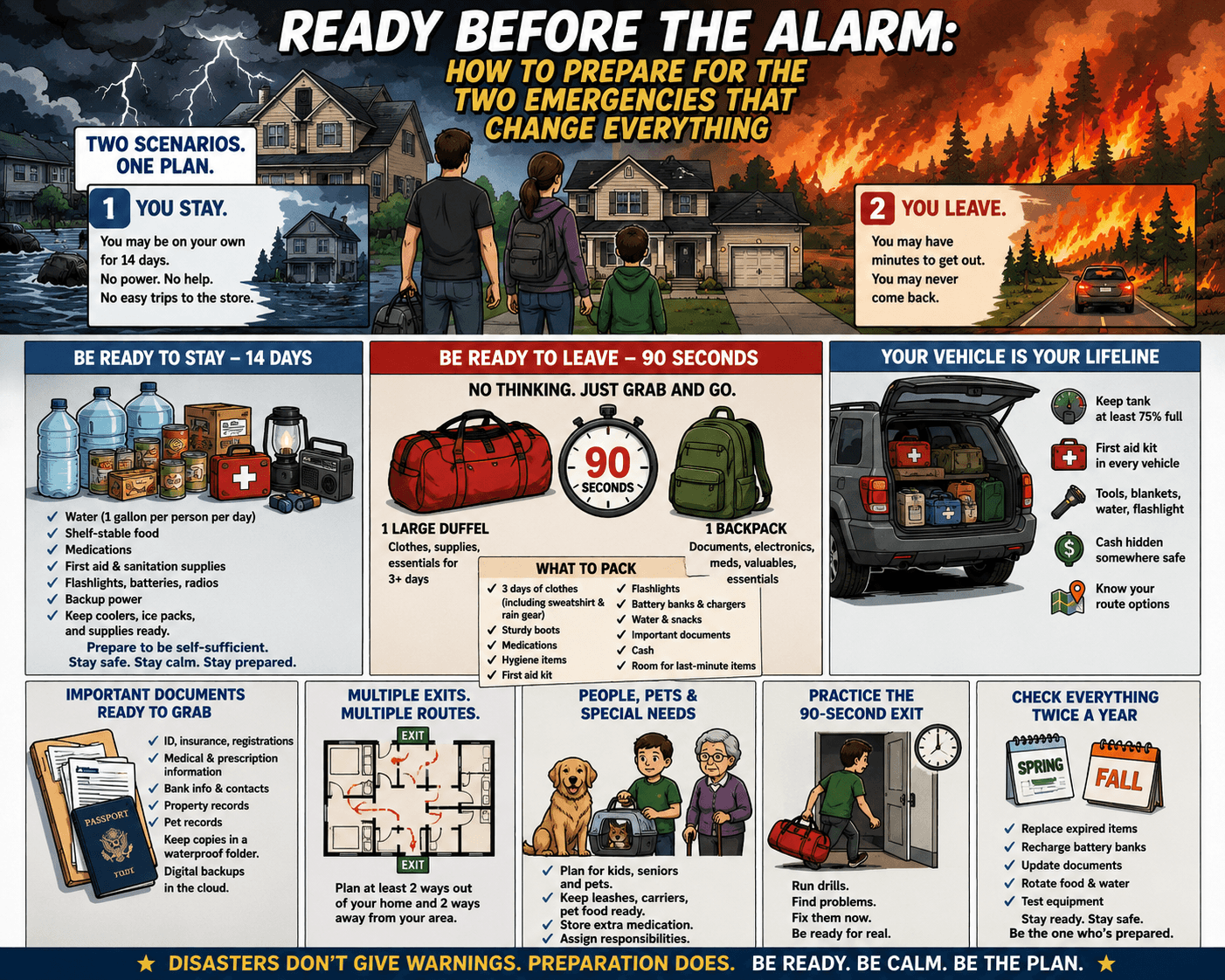
Ready Before the Alarm: How to Prepare for the Two Emergencies That Change Everything
Most emergencies fall into one of two categories. In the first, you stay.
The power is out. Roads are blocked. Communications are unreliable. Stores are closed. Emergency crews are overwhelmed. You may be on your own for 14 days.
In the second, you leave.
You may have only minutes to get out. You may not know where you are going. And you may never return to the home you are leaving behind.
Those two realities should shape your entire preparedness plan.
The goal is not to become paranoid.
The goal is to remove panic from the moment when panic is most dangerous.
Scenario One: You Stay
A serious storm, flood, wildfire, extended power failure or infrastructure breakdown may leave you isolated for days. Prepare to function without outside help for at least 14 days. That means having enough water, shelf-stable food, medication, sanitation supplies, lighting, batteries, backup power and basic first aid to remain safe without needing to make an emergency trip into town.
Keep coolers clean and ready.
Freeze ice packs and water containers ahead of time.
Keep battery banks charged.
Maintain flashlights, lanterns and radios in known locations. Do not scatter emergency equipment throughout the house. Store it where everyone can find it in the dark.
Your vehicle is also part of your survival system. Keep a first-aid kit, flashlight, blanket, basic tools, water and charging cable in every vehicle.
Scenario Two: You Leave
This is the harder scenario.
You are awakened at 3:30 in the morning from a dead sleep. An alert sounds.
Someone is pounding on the door.
Smoke is getting closer.
Water is rising.
You have 90 seconds.
That is not the time to decide what to pack.
Everything should already be positioned.
Every person should have one large duffel bag and one backpack. That is enough.
Anything more may become too difficult to carry, load or manage under stress.
The Clothes That Keep You MovingYour evacuation clothing should be practical, not fashionable. Keep sturdy boots ready.
Pack at least three days of clothing, including underwear and socks. Add a sweatshirt, rain gear and seasonally appropriate layers.
Keep the boots and bags near an exit point—not buried in a bedroom closet or hidden under storage boxes.
You should be able to get dressed, grab the bags and move. The Grab-and-Go SystemYour evacuation bags should contain the things you would need during the first few days away from home: Medication.
Basic hygiene supplies.
Phone chargers.
Battery banks.
Flashlights.
Water.
Snacks.
A compact first-aid kit.
Copies of important documents.
Emergency contact information written on paper.
A small amount of cash.
Do not pack the bags so tightly that nothing else fits.
Leave room for last-minute items such as medications from the refrigerator, your wallet, phone, laptop, pet supplies or documents that cannot remain inside the bag year-round.
Attach a short checklist to the outside of the bag.
When the emergency happens, you should not have to think.
You should simply follow the list.
Your Vehicle Must Be Ready TooKeep the fuel tank full whenever possible.
At minimum, try to keep it above three-quarters of a tank. During an evacuation, fuel stations may be closed, overwhelmed or without electricity. Traffic may force you to travel farther than expected, idle for long periods or take unfamiliar routes. Keep cash hidden in a secure place because card systems and ATMs may not work.
Store first-aid kits in the vehicles and backup supplies in your travel bags.
Know which vehicle will be used first.
Know where the keys are.
Know who is responsible for pets, documents and last-minute medication.
Important Documents Should Be ReadyPrepare copies of:
Identification. Insurance information. Vehicle registrations. Medical and prescription information. Bank and emergency contact information. Property records. Pet vaccination records.
Store paper copies in a waterproof folder and keep secure digital backups.
You do not want to search filing cabinets while smoke, water or fire is approaching.
Your Exit May Not Be the Front Door
Most people imagine leaving through their normal entrance. But the normal entrance may be blocked.
Walk through your home and identify backup exits.
Consider what happens if a hallway is filled with smoke, a tree blocks the driveway or water covers the main road.
Know at least two ways out of the home and two possible routes away from the property.
Keep evacuation bags near forward closets or exit points, but do not place every supply in one location. If one exit becomes inaccessible, you should still be able to reach critical equipment.
Prepare for People, Pets and Mobility Problems
Emergency plans often fail because they are designed for healthy adults moving quickly.
Plan for children, older adults, pets and anyone with limited mobility or chronic medical needs.
Keep leashes, harnesses, carriers and pet food ready. Store extra medication when permitted.
Make sure glasses, hearing aids, mobility devices and medical equipment can be reached quickly.
Assign responsibilities before the emergency.
One person handles pets.
One handles documents and medication.
One checks the vehicle.
No shouting.
No debating.
No searching.
Practice the 90-Second Exit
A plan that has never been practiced is only an idea. Run a drill.
Start in bed.
Pretend the power is out.
Get dressed.
Grab the bags.
Collect pets.
Take the documents.
Reach the vehicle.
Time the process.
You will quickly discover what is in the wrong place, what takes too long and what you forgot.
Fix those problems before a real emergency finds them for you. Check Everything Twice a Year
Preparedness equipment expires.
Batteries drain.
Clothing stops fitting.
Food spoils.
Medication changes.
Documents become outdated.
Check your bags, vehicle kits and home supplies twice each year. A good schedule is spring and fall, when weather patterns and clothing needs change.
Replace expired supplies.
Recharge battery banks.
Update documents.
Rotate food and water.
Test flashlights.
Review evacuation routes.
The Real Purpose of Preparedness
Preparedness is not about predicting every disaster. You cannot.
It is about building a system that works when you are tired, frightened, injured or confused.
When the warning comes, there should be no frantic packing. No searching for boots.
No hunting for chargers.
No argument over what to take.
Grab the checklist.
Grab the bags.
Grab the people and animals who depend on you. And move.
Because in the worst moments, the person who prepared ahead of time does not need to be fearless.
They only need to follow the plan. |
0 Comments
Join the conversation
Be the first to comment
Share your thoughts above.