
Kevin Rogers
Jul 5, 2026
Sunday July 5th 2026 |
Weekly Updates from the Ridge |
Trivia Question❓What is the largest county in Maine by land area and is known for its potato farming and winter sports? Answer at the bottom of the newsletter |
Weather |

Quote Of The Day |
"Every day may not be good, but there is something good in every day." |
Joke Of The Day |
It’s so hot in The County today, I saw a potato jump out of the ground and yell, |
Northern Maine Economic News This WeekWeek ending July 4, 2026 |
The biggest economic theme in Northern Maine this week is workforce, infrastructure, rural redevelopment, and household cost pressure. There is real grant money moving into the region, but families and small businesses are still dealing with high fuel, food, and labor costs.
1. Aroostook gets workforce money to fight population lossAroostook Partnership and Northern Maine Development Commission received a $360,000, two-year Northern Border Regional Commission grant to launch Aroostook Rising, a countywide talent attraction and retention effort. The goal is to bring in and keep skilled tradespeople, health care workers, entrepreneurs, remote workers, and other professionals. WAGM framed it as a direct response to years of population loss and workforce shortage in The County.
Why it matters: this is not just a marketing campaign. It lines up with what every employer is feeling: not enough workers, not enough younger families, and not enough replacement population for retirements.
2. Southern Aroostook forest economy gets a major boostSouthern Aroostook Development Corporation is receiving a $1 million Forest Economy Program grant to develop a modern forest-products manufacturing facility in the Houlton Industrial Park and lease it long-term to Kearney Pallet. The Governor’s office called it an investment in Southern Aroostook’s forest economy, wood products sector, future growth, and timber demand.
Why it matters: this is one of the strongest Southern Aroostook economic-development wins on the board right now. It connects forestry, manufacturing, industrial park use, and private business expansion.
3. Madawaska port-of-entry building is being turned into a brewpubThe former Madawaska port-of-entry building sold at auction for $173,000 and is now being redeveloped into a family-friendly brewpub. The owners are using a local profit-share model instead of traditional bank financing, offering shares of future profits to local investors. They also plan riverfront improvements with a deck and public water access, with hopes to open sometime in August.
Why it matters: this is a clean example of rural redevelopment: reuse an idle public building, create a destination stop, keep investment local, and tie the business to riverfront access.
4. Loring Commerce Centre water order lifted
The boil-water order at Loring Commerce Centre was lifted after corrective actions, system flushing, and water testing. Officials said water can again be used for drinking, cooking, food preparation, brushing teeth, and normal business purposes; food-service businesses may resume normal operations under applicable health rules.
Why it matters: Loring is one of the County’s most important industrial assets. Even temporary utility disruptions matter because they affect tenants, food service, worker confidence, and business continuity.
5. Senior-service economy gets supportAroostook Agency on Aging received a $123,000 AmeriCorps grant to strengthen volunteer programs for older adults and people with disabilities. WAGM reported the grant follows an expansion of Meals on Wheels earlier this year that nearly doubled the number of people receiving meals.
Why it matters: senior services are economic infrastructure in a rural county. They help older adults stay home longer, reduce pressure on families, and support the volunteer/service network that keeps communities functioning.
6. Public safety infrastructure moving in SinclairNorth Lakes Fire and Rescue secured a Congressional Directed Spending Grant for a new fire station in Sinclair, with officials saying the current 1940s-era building has been outgrown and that they plan to break ground this summer.
Why it matters: fire protection, EMS response, and emergency capacity are part of economic development. Businesses, insurers, residents, and visitors all depend on reliable emergency infrastructure.
7. Fuel costs remain a household and business pressure pointMaine’s current average gasoline price is about $3.86 per gallon, with diesel around $5.22. One month ago, Maine regular gas averaged over $4.31, so prices have eased, but they remain much higher than a year ago.
Heating fuel is still a concern heading toward fall. Maine’s latest heating fuel survey lists the Northern region at about $4.51 for heating oil, $5.29 for kerosene, and $2.87 for propane.
Why it matters: fuel prices hit everything in Northern Maine: home heating, trucking, farm inputs, tourism travel, construction, logging, delivery costs, and grocery prices.
8. Labor market remains tight statewide, weaker in AroostookMaine’s unemployment rate held at 3.1% in May, marking the 53rd straight month below 4%, the longest stretch on record. But Aroostook County’s most recent county-level figure was 5.7% in April 2026, the highest among Maine counties at that time.
Why it matters: that gap tells the story. Maine overall is tight, but rural counties still face seasonal work patterns, aging population, distance from markets, and persistent workforce mismatch.
9. Tourism and agriculture season are entering peak windowThe Maine Potato Blossom Festival runs July 11–19, 2026 in Fort Fairfield and is described as Aroostook County’s premier summertime event celebrating agricultural heritage. Visit Aroostook also lists upcoming July draws including Houlton Agricultural Fair, Potato Blossom Festival, Open Farm Day, and Tour de la Vallée.
Why it matters: July is when small businesses, restaurants, food trucks, gas stations, motels, campgrounds, vendors, and local attractions need to capture visitor dollars. |
Interesting Facts |
|
Q/A Questions |
Q: What is the largest county in Maine? A: Aroostook County. Q: What is the county seat of Aroostook County? A: Houlton. Q: What is the primary industry in Aroostook County? A: Agriculture, particularly potato farming. |
Grilling Fish |
Recreation news |
Current Conditions in Northern Maine: Food Prices, Fuel Costs, and What Families Should Watch This Summer |
Northern Maine families are not looking at an immediate “empty shelves” food crisis, but we are absolutely looking at a tighter household economy. The pressure is not coming from one single event. It is coming from several smaller problems stacking together: higher food prices, unstable fuel costs, expensive electricity, weather risk, fertilizer pressure, cattle shortages, and the long winter reality that every household in Aroostook County understands.
The practical takeaway is simple: do not panic, but do prepare. Right now, the biggest concern is not a nationwide food collapse. The bigger concern is affordability. USDA’s latest food price outlook shows several everyday categories still under pressure. Beef and veal prices were 12.9% higher in May 2026 than one year earlier, and USDA expects beef and veal prices to rise 7.5% for the year. The cattle herd has dropped to its lowest level in 75 years, which means beef prices are not likely to magically reset overnight. Fresh vegetables are another category to watch, with retail fresh vegetable prices forecast to rise 7.7% in 2026. Farm-level vegetable prices were 70.2% higher in May than a year earlier, which can show up later at the grocery store. Wheat is also a watch item, with USDA forecasting farm-level wheat prices up 21.1% in 2026.
There is some good news. Egg prices are expected to fall sharply in 2026 as production recovers from avian flu disruptions. USDA forecasts retail egg prices down 30.4% for the year. That means eggs may return as one of the better-value protein options for families, especially compared with beef.
For Northern Maine, the food concern is not just price. It is distance. We are at the end of a long supply line. When fuel gets expensive, trucking gets expensive. When storms disrupt roads, warehouses, or regional distribution, rural stores can feel it faster. When big cities absorb supply first, smaller rural markets can see fewer sale items, fewer choices, and higher prices. That does not mean shelves go bare. It means families should be smart about what they keep on hand.
What to Watch Over the Next Few Months
The first thing to watch is beef. If your household relies heavily on ground beef, roasts, steaks, or processed beef products, start planning alternatives now. Pork, chicken, eggs, beans, lentils, canned fish, peanut butter, and local meats may become more important parts of the family food plan.
The second thing to watch is fresh produce. Tomatoes, greens, peppers, onions, and other vegetables can move fast in price when weather, trucking, labor, or farm input costs tighten. Potatoes are one of our regional strengths, and local produce will matter more if national produce prices stay high.
The third thing to watch is flour, bread, pasta, cereal, and baked goods. Wheat is not in panic territory, but it is on the watch list. Families who bake, preserve food, or cook from scratch should pay attention to flour, yeast, oats, rice, pasta, pancake mix, and shelf-stable baking supplies.
The fourth thing to watch is fertilizer and farm input costs. USDA recently announced $500 million to expand domestic fertilizer production after fertilizer prices surged and global supply concerns increased. That matters because fertilizer cost does not just affect big farms out west. It works its way into feed, hay, vegetables, grain, dairy, and eventually the price on the shelf.
The fifth thing to watch is weather. NOAA’s Climate Prediction Center says El Niño conditions are present and expected to strengthen into the Northern Hemisphere winter of 2026–27. The current seasonal drought outlook shows a better chance of improvement or drought removal for central and northern New England, but drought persistence remains a concern in other regions that feed the national supply chain.
What to Stock Up On Without Hoarding
The goal should be a practical pantry, not panic buying. A good target for many households is a two-to-four-week buffer of basic food and household supplies. Families with seniors, kids, medical needs, pets, or long driveways may want a little more.
Good items to build slowly include rice, oats, pasta, flour, cornmeal, pancake mix, dry beans, lentils, canned beans, canned vegetables, canned fruit, tomato sauce, shelf-stable milk, powdered milk, peanut butter, tuna, sardines, canned chicken, soups, broth, coffee, tea, cooking oil, salt, sugar, baking powder, yeast, spices, and pet food.
For freezer planning, think carefully. A freezer full of meat is useful only if the power stays on or you have backup power. If you buy meat in bulk, have a plan for outages. That means a generator, fuel, a battery backup, or a neighbor/family plan. In Northern Maine, a full freezer is common sense, but it should be treated like an investment that needs protection.
For local food security, this is the year to support farm stands, local growers, small meat producers, potato growers, bakers, and food trucks that use local ingredients. Every dollar kept in the regional food system helps build resilience.
Energy Prices: The Northern Maine Winter Is Already on the CalendarFood is only half the household budget story. Energy is the other half. As of June 29, 2026, Maine’s Department of Energy Resources listed statewide average heating oil at $4.50 per gallon. In the Northern region, the listed average was $4.51. Kerosene averaged $5.29 in the Northern region, while propane averaged $2.87. The state notes that prices can vary by region and household situation, and propane prices are based on customers using at least 900 gallons per year, meaning smaller users may pay more.
That matters because many Northern Maine homes still depend on heating oil, propane, kerosene, wood, pellets, or a combination of fuels. A cold winter, a supply interruption, or another oil market spike could put serious pressure on household budgets.
Electricity is mixed. Maine reported that as of July 1, 2026, average bills decreased by about $11 for CMP customers, about $6 for Versant Bangor Hydro District customers, and about $3 for Versant Maine Public District customers. That is helpful, but it does not erase the larger reality that electricity remains a major household cost, especially for homes using heat pumps, electric hot water, freezers, well pumps, or electric backup heat.
One important detail: the federal EIA does not collect weekly residential heating oil and propane price data during the summer. Those weekly updates return in October. That makes Maine’s state fuel-price survey especially useful during the off-season.
Energy Prep Before Fall
The best time to prepare for winter heat is not during the first snowstorm. It is now.
Start by checking your fuel tank level and setting a plan. If you heat with oil, kerosene, or propane, consider buying in stages instead of waiting until the first cold snap. Ask your supplier about pre-buy, budget plans, automatic delivery, minimum delivery amounts, and emergency delivery policies.
Second, service the furnace, boiler, monitor heater, pellet stove, or wood stove before the fall rush. A dirty or inefficient heating system burns money. Replace filters, clean vents, check thermostats, inspect chimneys, and make sure carbon monoxide detectors are working. Third, seal the obvious leaks. Plastic on older windows, door sweeps, attic hatch insulation, basement air sealing, pipe insulation, and heavy curtains can make a real difference. In an old farmhouse, sometimes the cheapest fix is the one that stops the draft.
Fourth, protect the freezer. If you are stocking meat, vegetables, or prepared meals, have an outage plan. Keep the freezer full, add frozen water jugs to empty space, keep a thermometer inside, and avoid opening the door during outages.
Fifth, apply early for help if you qualify. MaineHousing says HEAP applications for the next heating season begin August 3, 2026. The program helps qualified homeowners and renters with heating costs, emergency fuel delivery, energy-related repairs, and utility payments. Households are encouraged to apply as early as possible.
The Sensible Northern Maine Plan
The smart move is not fear. It is old-fashioned County common sense. Keep a pantry. Fill the freezer carefully. Watch beef and vegetable prices. Buy local when possible. Pay attention to wheat, coffee, cooking oil, and fuel. Get the heating system checked before everyone else calls. Build a small cash buffer if possible. Keep batteries, flashlights, drinking water, pet food, and basic medicine on hand.
Northern Maine has always required a little more planning than places closer to the big warehouses and big highways. That is not a weakness. It is part of how people here have always lived.
This summer, the message is simple: shop smart, store wisely, support local, and get ready before the cold comes. |
Maine Birding |
Tip of The Day |
Don't forget to check out the beautiful star-filled sky in Aroostook County - it's the perfect place for stargazing! |
Northern Maine Recreation Economy Brief |
Secret Little Hack |
Explore the hidden gem of Conroy Lake for stunning views and serene nature walks. |

Introducing Shady Ridge Disc Golf — a course forged from an ambitious vision: provide a two-time World Champion with the space, creativity, and permission to design the ultimate disc golf challenge. Read More... |

Nonprofit Spotlight of the Week: Houlton Humane Society
This week, we’re encouraging our community to support the Houlton Humane Society.
They do the hard, quiet work of caring for local animals, helping pets find safe homes, and supporting the bond between people and their animals across Southern Aroostook.
Whether you can adopt, foster, donate food or supplies, volunteer, or simply share their posts, every little bit helps.
A strong community takes care of its people — and its animals. Let’s show some love this week for the pets waiting for their next chapter. |
|
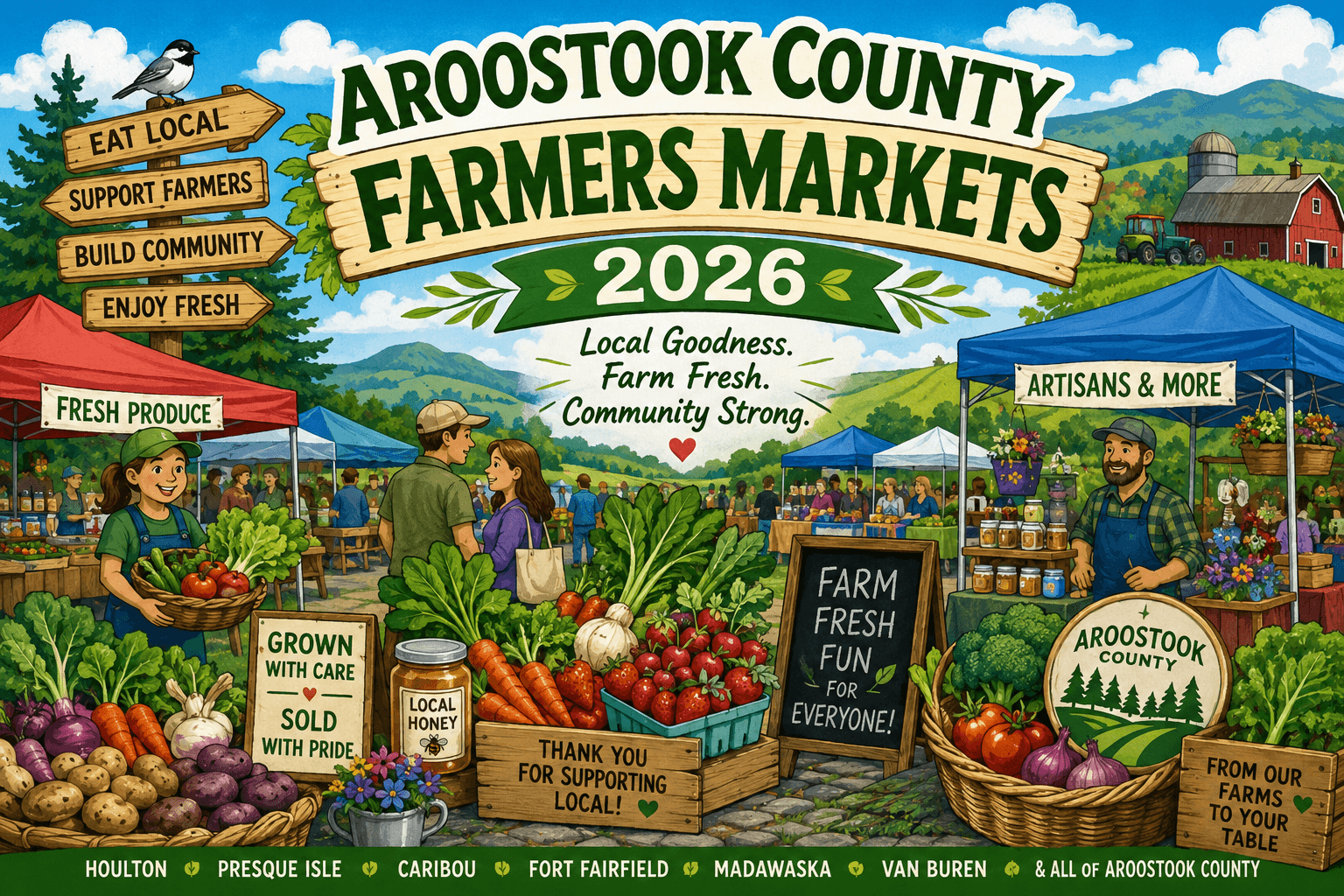
Summer mornings in Aroostook County offer a unique charm that captures all your senses.
The air is filled with the warm scent of fresh baked goods, while locally grown vegetables and sweet maple syrup from neighborhood sugarhouses line vibrant farmers market tables.
Handcrafted items made by talented local artisans add even more personality to the scene.
Every visit brings a chance to meet the growers, bakers, and crafters who shape the community’s character.
Whether you’re a lifelong resident or simply exploring Northern Maine for a weekend, stopping by a farmers market is one of the most authentic ways to experience everything the region has to offer. Read More... |
💡 Answer to Trivia Question: Aroostook County |