
Kevin Rogers
Jul 19, 2026
Sunday July 19, 2026 |
Trivia Question❓During World War II, which branch of the U.S. military established Loring Air Force Base in Aroostook County, making it one of the northernmost Strategic Air Command bases in the continental United States? Answer at the bottom of the newsletter |

Quote Of The Day |
There is a particular silence in the north that does not ask to be filled — it simply waits, patient as a potato field in October, certain that something worthwhile will grow. |
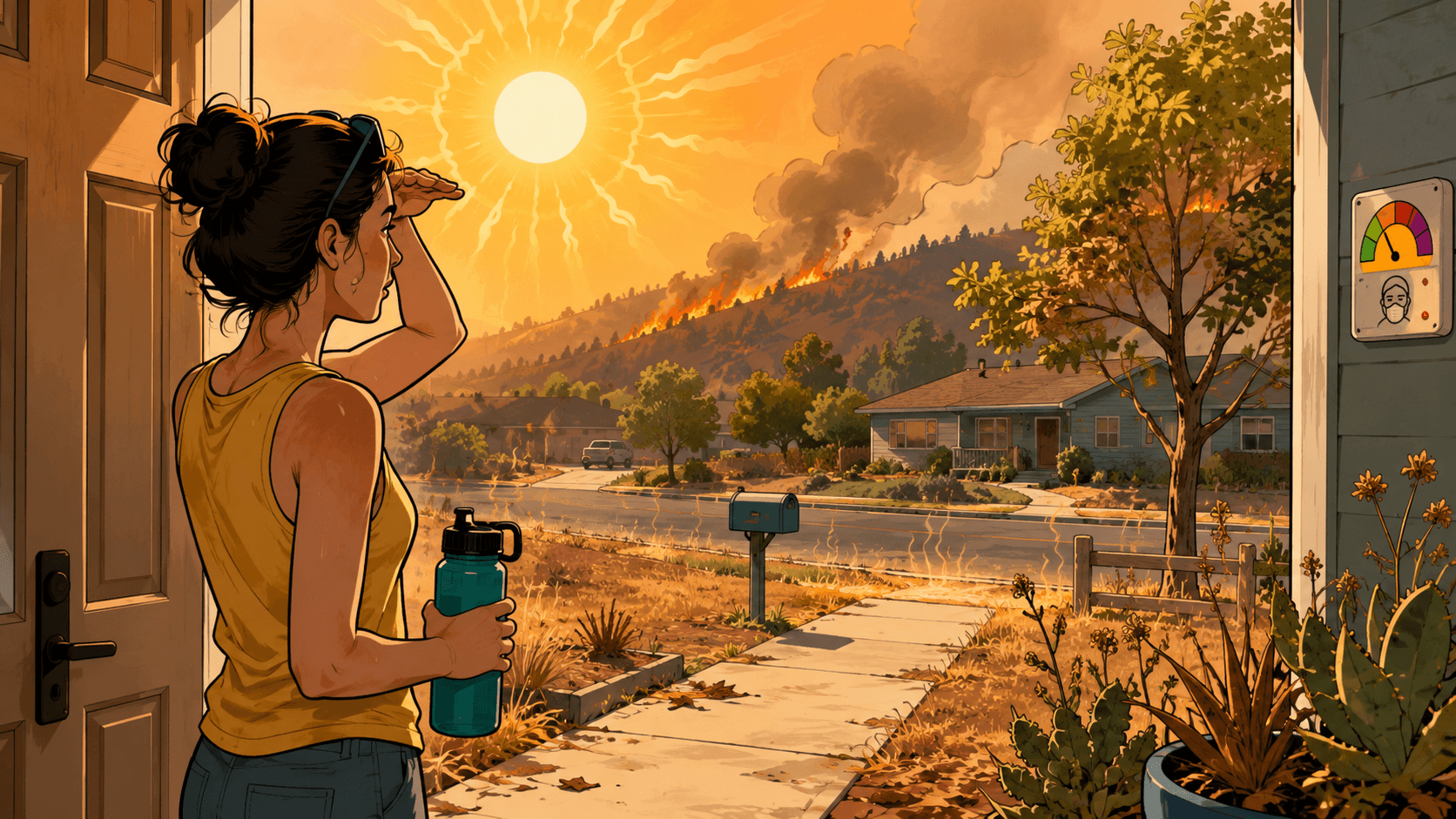
This summer's dangers don't always announce themselves with sirens or storm clouds. Extreme heat, wildfire smoke, and drought-driven fires are creating a new kind of invisible emergency — one that can feel like a clear, ordinary day right up until it isn't.
As of mid-July 2026, over 100 wildfires are burning across Canada, pushing smoke deep into the Midwest, Northeast, and Maine. Billings, Montana hit 111°F; Salt Lake City reached 109°F. A late-June European heatwave was linked to more than 10,000 excess deaths.
Fine smoke particles — invisible to the eye — can damage lungs and trigger heart and respiratory conditions, even when fires burn hundreds of miles away.
Experts urge everyone to check both temperature and Air Quality Index before heading outside, watch for early heat symptoms like dizziness or fatigue, and always carry water and a plan.
The warning signs are already there — you just have to know where to look. Read More... |
Joke Of The Day |
Aroostook County is so far north in Maine that locals don't say "good morning" — they say "good eventually." The sun clocks in late up there, and honestly, who can blame it? |
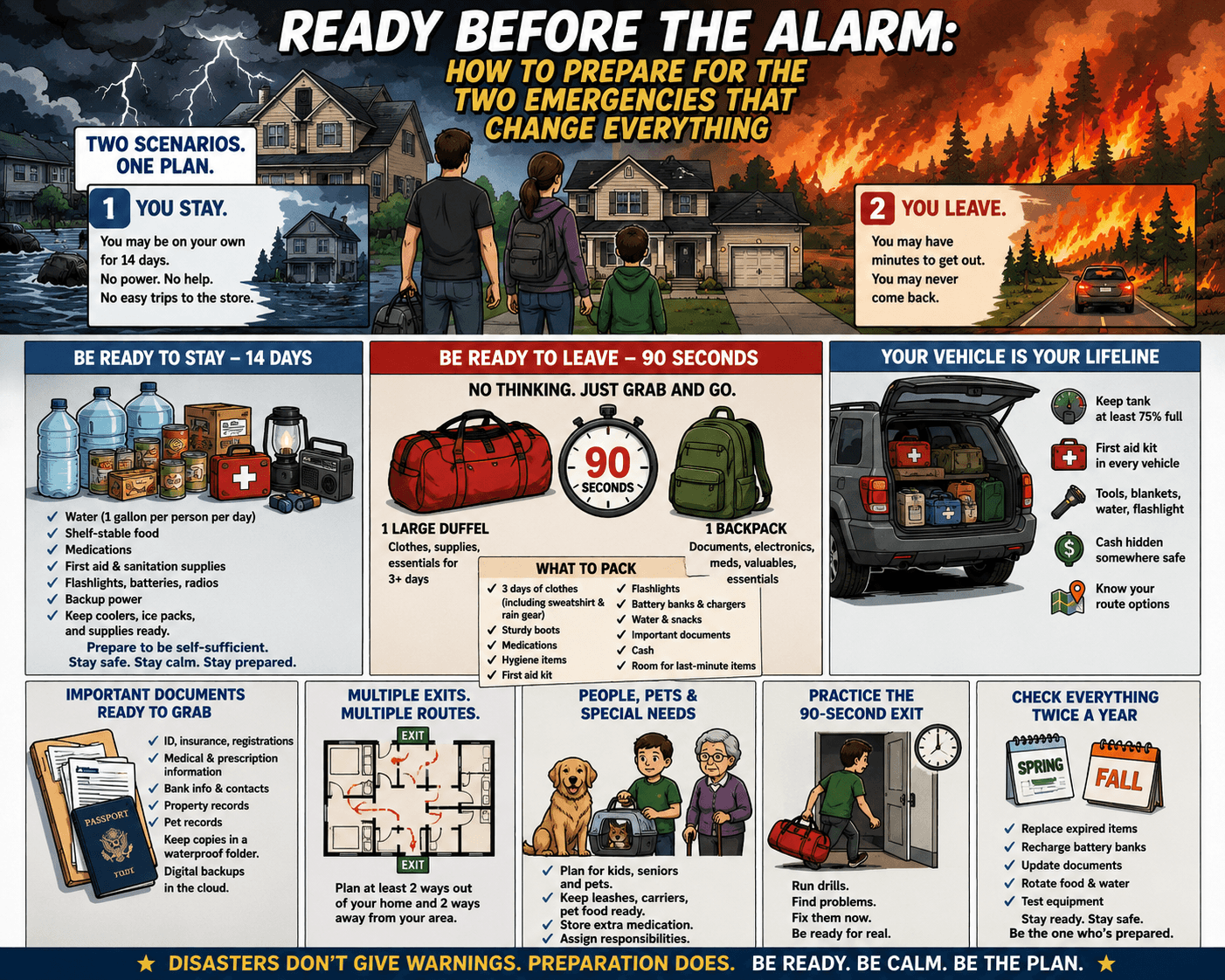
Most emergencies fall into one of two categories: you stay, or you leave.
If you stay, plan to be self-sufficient for at least 14 days — with water, food, medication, lighting, and backup power stored and accessible to everyone in the household.
If you leave, you may have only 90 seconds. That means grab-and-go bags must already be packed and positioned near an exit — not buried in a closet.
Each person should have one duffel and one backpack containing essentials: medication, chargers, cash, documents, first aid, and snacks. Attach a checklist to the outside so there's no guessing under pressure.
Keep your fuel tank above three-quarters full, know your backup exit routes, and assign roles to every household member — including responsibility for pets and medical equipment.
Run a timed drill. Review everything twice a year. The goal isn't fearlessness — it's a plan you can follow when fear is loudest. Read More... |
Interesting Facts |
Aroostook County, Maine hides some genuinely remarkable details beneath its quiet, rural surface.
|
Q/A Questions |
Q: Why do so many roads in Aroostook County follow perfectly straight lines for miles on end? A: Much of "The County" was surveyed and settled in the 19th century on a grid system to divide farmland efficiently across the largely flat, open terrain. Because there were few natural obstacles and the land was being carved up for agriculture rather than built around existing settlements, planners could run roads in long, unbroken stretches — a layout that still shapes the landscape today. Q: Is Aroostook County really larger than some U.S. states? A: Yes — at roughly 6,800 square miles, Aroostook County is larger than both Connecticut and Rhode Island combined. Despite this enormous size, it has a relatively sparse population of around 65,000 people, making it one of the least densely populated counties east of the Mississippi River. Q: What role did Aroostook County play in one of the strangest almost-wars in American history? A: The county was the center of the Aroostook War of 1838–1839, a bloodless standoff between American settlers and Canadian lumbermen over a disputed border with the British province of New Brunswick. Both sides mobilized militias and Congress authorized funds for a potential conflict, but the crisis was resolved diplomatically through the Webster-Ashburton Treaty of 1842, which formally established the current U.S.-Canada boundary in the region. |
America's Triple Threat Summer: |
Smoke, Floods, and Fire Stretch Emergency Resources Nationwide |
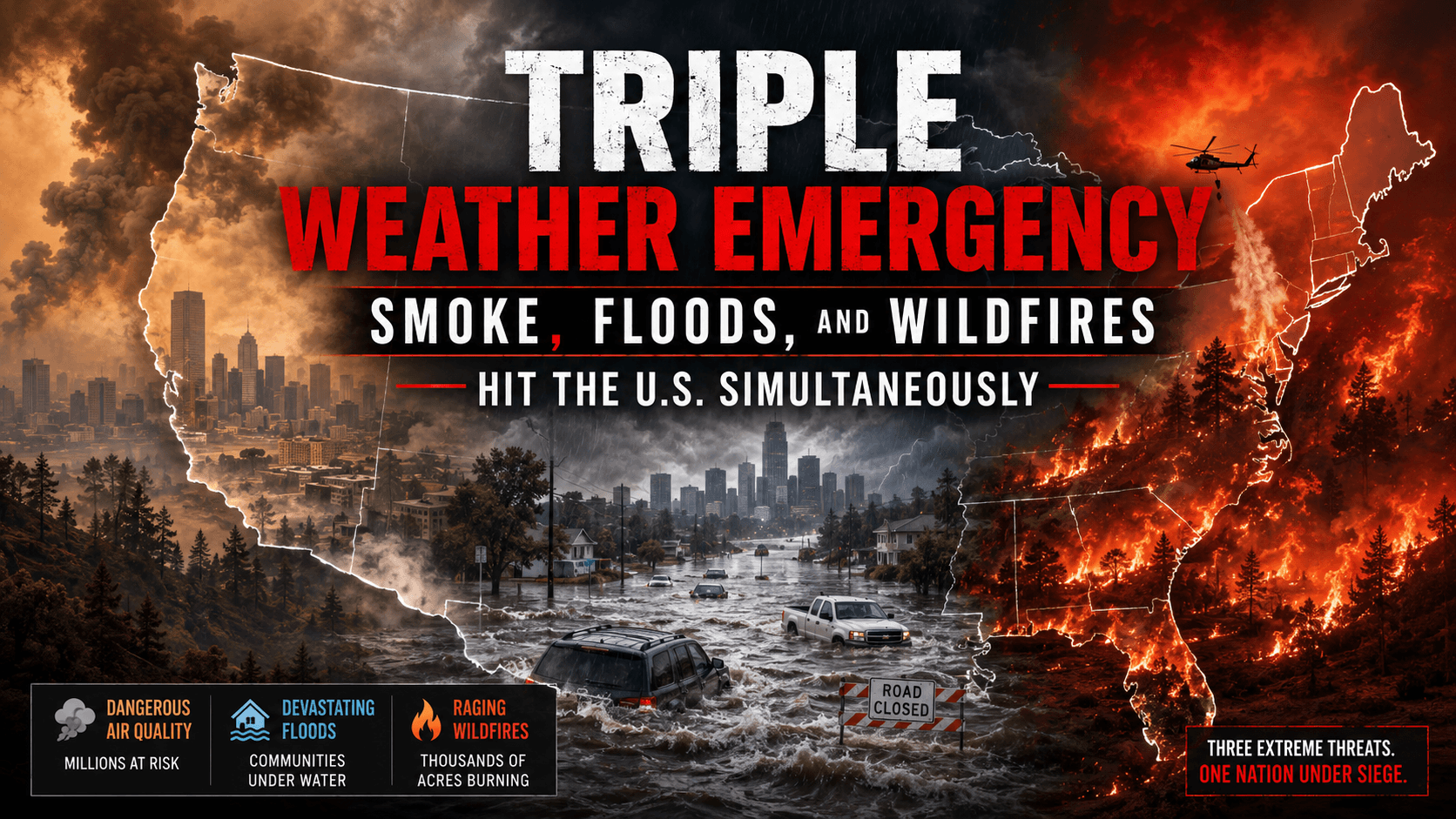
Triple Weather Emergency: Smoke, Floods, and Wildfires Hit the U.S. Simultaneously
The United States is dealing with three major weather disasters at once:
Fire agencies report 68 active wildfires across 15 states, with more than 17,400 firefighters and support personnel deployed. More than 3.7 million acres have burned nationwide this year, already exceeding the acreage burned during the same period in 2025.
Why it matters
These overlapping events illustrate how communities can face multiple hazards simultaneously rather than one disaster at a time, increasing demands on emergency services and complicating evacuations and recovery. |
Tip of The Day |
Create a Personal Weather Alert System Instead of relying solely on generic weather apps, customize your alerts: choose a free service that lets you set up text or email notifications for specific conditions, like frost advisories or wind gusts above a set speed in your area. You’ll get the details you actually care about—like avoiding icy steps on your morning walk or knowing when to bring pets inside—without wading through endless notifications. Take two minutes today to tailor your weather notifications for smarter, stress-free preparedness. |
Eyes Wide Open |
Finding Peace While the World Loses Its Mind |
 |
It has been a busy weekend, and sometimes the noise of the world feels impossible to escape.
Everywhere we look, something appears to be unraveling. Wars, political battles, economic uncertainty, extreme weather, new technology, cultural division, and a constant stream of warnings compete for our attention. Every headline tells us that something is breaking, changing, collapsing, or about to become a crisis. It is easy to become overwhelmed.
It is also easy to believe that we must understand everything, predict everything, and somehow prepare for every possible outcome. We scroll, analyze, argue, worry, and mentally rehearse disasters that may never happen. We convince ourselves that if we gather enough information, we might finally feel safe.
But certainty rarely arrives.
The truth is that we may have some ability to influence our fate, but probably not as much as we would like to believe.
We can make plans. We can prepare. We can vote, save money, build relationships, protect our families, and make thoughtful decisions. Those things matter. Personal responsibility matters. But life still contains forces that are far beyond our control.
Governments change direction. Markets rise and fall. Storms appear. Technology advances. People make unexpected choices. The world keeps moving, often without asking our permission. There is peace in finally admitting that.
Surrender does not mean giving up. It does not mean ignoring danger, abandoning responsibility, or pretending everything is fine. Surrender means releasing the illusion that we can control every outcome.
It means doing what we reasonably can and then allowing life to unfold.
There is a difference between being informed and being consumed. There is a difference between preparedness and panic. There is a difference between watching the world with open eyes and allowing every headline to move into your nervous system and start rearranging the furniture.
We should pay attention.
We should see what is happening.
But we do not have to absorb every crisis as though it is happening inside our own living room.
Sometimes the healthiest approach is to step back and watch the world almost as if it were a strange television show.
The characters are dramatic. The plot makes very little sense. The people in charge frequently appear to be improvising. Every season introduces a new crisis, several unnecessary villains, and at least one storyline that should have been canceled years ago.
Somewhere, a committee is probably holding a meeting to decide when to schedule the next meeting.
Once you see the absurdity, laughter becomes possible. Laughter is not denial. Sometimes laughter is what keeps reality from crushing us. It creates a little distance between ourselves and the madness. It reminds us that human beings have always been strange, contradictory creatures trying to look confident while mostly making things up as we go.
Sarcasm can be useful because it exposes the ridiculous parts of life that serious language cannot always reach.
When someone tells us that everything is under control, sarcasm quietly asks, “Whose control?”
When leaders promise that a temporary solution will permanently fix a problem created by the last temporary solution, sarcasm gives us the emotional strength to keep listening without throwing the radio into the woods.
Used carefully, sarcasm is not bitterness. It is perspective wearing work boots.
Still, we must be careful not to let humor harden into cynicism. Cynicism says nothing matters. Wisdom says many things matter, but not everything deserves our fear.
That distinction is important.
The goal is not to become numb. The goal is to remain awake without becoming terrified.
Eyes wide open.
Feet on the ground.
Heart still intact.
We can witness the chaos without joining it. We can prepare for uncertainty without worshiping it. We can accept that the future is unwritten without imagining that every blank page contains a catastrophe.
Often, peace is found in returning to what is directly in front of us. A meal.
A dog sleeping nearby.
A conversation with a friend.
A quiet road.
Rain against the window.
Work that needs to be done.
A familiar song.
A moment of laughter that reminds us we are still alive. These ordinary things are not distractions from the real world. They are the real world.
The headlines may describe history, but daily life is still built from small moments. Most of us do not experience the world as a grand geopolitical event. We experience it through kitchens, backyards, workplaces, family relationships, financial decisions, weather, health, and community.
That is where our real influence lives.
We may not be able to direct the entire river, but we can learn how to travel with the current. We can steer around obvious hazards. We can help someone else stay afloat. We can rest when the water is calm. We can stop fighting every wave as if nature has personally offended us.
Surrendering to the flow is not weakness. It is recognizing when effort is useful and when resistance is only exhausting us.
There will always be uncertainty. There will always be people announcing the end of the world, usually just before a commercial break. There will always be another crisis, argument, prediction, scandal, or emergency demanding our complete emotional participation.
We are allowed to decline the invitation.
We can remain informed without surrendering our peace.
We can prepare without living in fear.
We can take life seriously without treating every moment as a funeral.
And when the world becomes especially absurd, we can laugh—not because nothing matters, but because joy, humor, and perspective are among the few things chaos cannot take from us unless we willingly hand them over.
So watch the show.
Keep your eyes open.
Do what you can.
Release what you cannot control.
And when the plot becomes completely unbelievable, remember: sometimes laughter really is the best medicine. It just takes a little sarcasm to help it go down. |
💡 Answer to Trivia Question: The U.S. Air Force (Army Air Forces, later U.S. Air Force) |